
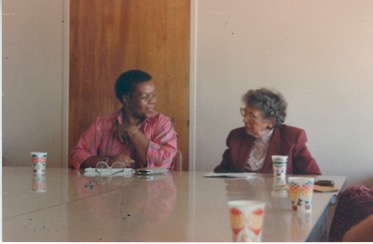
Dr. Abby Gondek, Morgenthau Scholar-in-Residence, FDR Library, Hyde Park, NY
PhD Global and Socio-cultural Studies, Florida International University
MA African and African Diaspora Studies, FIU
MA Women’s Studies, SDSU
Part of the panel: MuSeums as Sites of and for research
American Anthropological Association Meeting, November 22, 2019, Vancouver, BC
Abstract
Originally titled: The Swazi clothing and adornment collection at the UCLA Fowler Museum: A transnational collaboration between Hilda Kuper and Thoko Ginindza
Hilda Kuper was a Jewish political-legal anthropologist, novelist and playwright, born in Bulawayo, Rhodesia in 1911. She grew up in Johannesburg, South Africa. She received her anthropological training with Winifred Hoernlé at the University of Witwatersrand. She also trained with Bronislaw Malinowski at the London School of Economics. Kuper is best known for her research in Swaziland. She became a citizen there in 1970. Hilda took a “Swazi point of view.” She argued that Westernization weakened women’s position. Very little has been written about Hilda’s collaboration with Swazi anthropologist, Thoko Ginindza (1942-1996).
Nothing has been published about their Swazi artifact collection at the UCLA Fowler Museum. However, these Swazi women’s clothing and adornment items offer tangible evidence of the transracial and transnational collaboration between Kuper and Ginindza.
Hilda and her husband, Leo Kuper, came to UCLA after increasing police surveillance made staying in South Africa untenable. Hilda eventually became a Professor in Anthropology at UCLA. In 1967, Thoko wrote to Hilda, whom she knew from Swaziland. She asked for Hilda’s assistance to attend UCLA. Thoko earned a MA in African Studies there in 1972. Their shared research emphasized the impact of colonization and the traditional Swazi aristocracy on women’s roles in Swaziland, manifested through gendered clothing norms.
This presentation provides a history and visual analysis of the Swazi collection and their research relationship through correspondence between Kuper and Ginindza and fieldwork photographs from the Hilda Kuper Papers held in the UCLA Special Collections.
If this Project is helpful to you, please consider making a one-time donation to fund Dr. Abby’s continued research. I also encourage you to become a member of my subscription program, “Not too shabby, Abby!” where you can access premium content on my site.
Consider funding my research on an ongoing basis. Make a monthly donation! I also encourage you to become a member of my subscription program, “Not too shabby, Abby!” where you can access premium content on my site.
Consider funding my research for the year. Make a yearly donation! I also encourage you to become a member of my subscription program, “Not too shabby, Abby!” where you can access premium content on my site.
Choose an amount
Or enter a custom amount, I encourage you to donate in multiples of $18, $36 or $54 (The number 18 is the symbol of “Chai” or life, in Jewish culture).
Your contribution is hugely appreciated. I am an adjunct instructor, so I have no research budget, but I want to create innovative content for my site and for you, my readers. Your contributions make my work possible. Thank you for your generosity.
Your contribution is hugely appreciated. I am an adjunct instructor, so I have no research budget, but I want to create innovative content for my site and for you, my readers. Your contributions make my work possible. Thank you for your generosity.
Your contribution is hugely appreciated. I am an adjunct instructor, so I have no research budget, but I want to create innovative content for my site and for you, my readers. Your contributions make my work possible. Thank you for your generosity.
DonateDonate monthlyDonate yearly
Goals
This presentation raises awareness about the Swazi collection held at the UCLA Fowler Museum. It investigates the long-term research relationship between women that crossed racial and national borders. This collaboration occurred between a Black Swazi woman anthropologist and a Jewish Rhodesian/South African woman anthropologist.
Museum collecting and anthropological theorizing is a collaborative project and not one done in isolation. I especially want to highlight the work of women of color and indigenous women. They have done and continue to do much of the ethnographic labor and theorizing. This work made and makes these collections and writing projects possible. Lyn Schumaker’s Africanizing Anthropology (2001) has been especially influential for my thinking in this regard.
My dissertation explored theories related to these politics of knowledge production and canon creation in much more depth. This presentation is part of a larger project. It investigates how and why Jewish women social scientists throughout the Jewish and African diasporas wrote about Black women. This reflects Jewish women’s positionality within racial, political, class, and other institutional and professional networks.
I center on the material connections between Thoko Ginindza and Hilda Kuper. I cross-reference multiple forms of evidence. This evidence documents the formation of the Thoko Ginindza Swazi artifact collection at the UCLA Fowler Museum. I also include images of the artifacts in the collection.
I interweave the following sources with a strong emphasis on the objects themselves:
- correspondence between Thoko and Hilda about the collection
- Thoko’s description of the objects she collected both in the digitized description of the collection and her handwritten and photocopied field notes that accompanied the collection (both of which Erica P. Jones at the Fowler Museum shared with me)
- photographs of the objects in the collection that I took when I visited the museum in 2016
- photographs from the Hilda Kuper Papers that display the clothing and adornment items found in the collection (some of the photos show Hilda wearing some of these types of items)
- Thoko’s writings including a paper she wrote in 1971 “Dress in Swaziland” for Hilda’s anthropology course & Hilda’s related 1973 article “Costume and Identity” which drew upon Thoko’s work
- Thoko’s Statement of Purpose (1974) written to gain admission to a PhD in Anthropology at UCLA & Hilda’s corrections to it
- Hilda’s academic and creative writings about Swaziland and Thoko’s development -oriented writing about Swazi women
My main argument is that Thoko’s labor (collecting, writing, researching) powerfully informed Hilda’s writing and theorizing. In turn, Hilda enabled Thoko’s transnational access to UCLA. Thoko collected artifacts and data for Hilda. Thoko wrote about Swazi clothing and adornment and Hilda utilized this information for her own writing. The collection at UCLA would not exist without their collaborative partnership. In addition, I argue that Thoko was working in a more “feminist” direction than Hilda was comfortable with. Thoko critiqued Swazi patriarchal systems in a way that Hilda did not, at least in her academic writings. However, in Hilda’s creative writing, a simultaneous critique of colonialism and patriarchal indigenous systems is apparent.
Organization
- Introduction: How did I learn about their collaboration and the Swazi artifact collection at UCLA? Correspondence and detailed explanations of clothing items mentioned in Thoko’s letter. Photographs of items from the Swazi collection at UCLA and from the Hilda Kuper Papers.
- Development of relationship between Thoko and Hilda & Hilda’s revisions of Thoko’s statement of purpose (from the Hilda Kuper Papers correspondence): this is the lead up to the beginning of the collection process
- Specific objects in the Swazi collection and their meanings/uses
- An explanation of Hilda’s perspectives regarding women in Swazi society & Thoko’s writings about women
Subscribe to get access
Introduction
During my first trip to the Hilda Kuper Papers in May 2016, I learned of the collaboration between Hilda and Teresa Thoko Ginindza. I came across letters between Hilda and Thoko in which Hilda asked Thoko to collect Swazi artifacts to form an object collection at the ethnology museum at UCLA .
Read more of this Introduction. View photographs from the Hilda Kuper Papers and of the Thoko Ginindza object collection. Subscribe today to gain access.
Subscribe to get access
Tidvwaba (the plural form of sidvwaba): In the fall of 1971, Ginindza submitted a paper called, “Dress in Swaziland” for Hilda’s course, Anthropology 107a. Hilda gave the paper an A-. Thoko focused on Swazi gendered clothing norms in this paper. She spoke of a specific skirt, made of cattle or ox hide, that only married women (or mothers) wore called a sidvwaba. This skirt was so heavy it “broke the waist” (p. 1)
Read more about the Thoko Ginindza collection, Hilda and Thoko’s correspondence, and Thoko’s statement of purpose for graduate school, when you subscribe today.
Umgcula
Umgcula: This is a “cloak”, “worn as a shawl by women only.” This design was developed for Swazi independence in 1968 “as a souvenir”; it contains the “same colors as the flag” and the shield at the center is also found on the Swazi flag (p. 7 of Thoko’s Field Notes, stapled to Acquisition Cover Sheet, and Record and Receipt of Incoming Objects ).
Thoko calls this an “overall piece” worn over all the other items of women’s attire she describes in her paper: “Dress in Swaziland” for Hilda’s Anthropology 107a in Fall 1971, see p. 6. She explains that this piece of clothing covers the whole body, from shoulder to ankle.
Subscribe to get access
Beadwork: Ligcebesha
“Ligcebesh [represented in the collection at the Fowler museum] is worn around the neck and has two pieces with the same design at the front. These are woven into a string long enough to go round the neck. Instead of ligcebesha, ingciba may be worn, it is very similar to the ligcebesha, the only difference being that unlike ligcebesha, ingciba does not have the two pieces. Sigcizo is worn around the wrist and the ankles” (Ginindza, “Dress in Swaziland”, 1971, p. 8).
Read more about ligcebesha, & umgcula and see photographs of them in the Thoko Ginindza collection by subscribing today.
Hilda’s Swazi affiliations & Perspectives
Casey Golomski indicates that Hilda’s perception of “traditional” Swazi customs likely stems from recent reintroductions initiated by King Sobhuza II in the 1920s and ’30s, which Hilda helped frame as traditions through her writings. These changes aimed to revive the “militaristic regimental age system” known as emabutfo to reinforce Sobhuza’s royal power and influence over national identity (Golomski 2011, 8–9). Hugh MacMillan (1995) notes that while Kuper valued studying history and social change, she downplayed the discontinuities in Swazi “traditions” to support a royal and elite perspective (Macmillan 1995, 559–61). Leroy Vail and Landeg White (1991) argue that Hilda’s writings about Sobhuza advanced his propaganda efforts to promote Swazi “tradition” in favor of his monarchy (Golomski 2011, 9; Vail and White 1991, 179, 192).
Golomski, Casey. 2011. “Hilda Kuper, Anthropology, History.” In University of Swaziland, UNISWA, History Staff Seminar Series, 21. University of Swaziland, Department of Theology and Religious Studies.
Macmillan, Hugh. 1995. “Administrators, Anthropologists, and ‘Traditionalists’ in Swaziland: The Case of the ‘AmaBhaca’ Fines.” Africa 65 (4): 545–64.
Vail, Leroy, and Landeg White. 1991. Power and the Praise Poem: Southern African Voices in History. University Press of Virginia.
In a 1979 interview with her student, Gelya Frank, Kuper argued that Westernization worsened women’s status in Swazi society, stating, “The westernized Swazi man retains the most terrible chauvinist attitude toward women.” Hilda believed that polygamy reflected a respect for women within this culture. She cited an instance where Sobhuza II, the King of Swaziland and her research sponsor from 1934 to 1978, had to sit on the ground when his elder sister entered the room with Hilda. Hilda emphasized that age, rank, and sex were significant factors, arguing against the notion that women were inferior in Swazi society. Instead, she preferred the term “complementarity” (Frank and Kuper 1979, 17–18).
Frank, Gelya, and Hilda Kuper. 1979. “Rough Transcript Interview Conducted by Gelya Frank with Hilda Kuper Re: Ethics/Morality of Life History Work and Hilda’s Biography of Sobhuza II, June 28, 1979.” Los Angeles: Hilda Kuper Papers, Box 16, Folder 5, UCLA Special Collections, Charles E. Young Research Library.
Subscribe to get access
A Witch in my heart- Hilda’s Creative Writing
Hilda tended to portray women as victims rather than as empowered and creative resistors to hierarchical and patriarchal structures. As Kuper depicted in A Witch in my Heart, Swazi wives, who were considered outsiders in their husband’s patrilocal family, were required to conform to strict rules. If one of the wives (in this story her name is Bigwapi) demonstrated any extraordinary talents including cooking, gardening or creativity, and if a tragedy befell the family (such as the death of a co-wife’s child), they were deemed a witch (and murderer of the child) by male diviners. Fathers-in-law were responsible for hiring these male diviners. If (& when) the non-conforming co-wife (in this story Bigwapi) was found guilty of witchcraft she was banished to her natal home, where she continued to be dreaded and feared. Even if the woman’s husband did not want her banished, he was forced to obey his father, who was the ultimate head of power; the father-in-law maintained the stability of the male controlled family and protected co-wives from what were considered non-conforming and aberrant wives (Kuper and Institute 1970, xiv–xxvi).
Kuper, Hilda, and International African Institute. 1970. A Witch in My Heart: A Play Set in Swaziland in the 1930s. Oxford U.P.
The Swazi mother- in-law character in Kuper’s play A Witch in My Heart, seemed to blame the Swazi patriarchy for Bigwapi’s exile when she stated “the law of our people is hard on women” (Kuper and Institute 1970:56). Bigwapi’s banishment can also be partly explained by the colonial system that not only forced Swazi men to journey to cities for access to money, but also imprisoned them unjustly for drinking beer in privately-run bars.
Read more about Hilda’s publications about Swazi society when you subscribe today. In the special sections for subscribers only, I discuss Uniform of Colour and “Costume and Identity.”
Thoko’s writings about women
Thoko cited Hilda’s An African Aristocracy (1947) frequently in her 1989 report “Swazi Women: Sociocultural and Economic Considerations” in Chapter 3 about Traditional Role of Swazi Women. For example, “The importance of the mother and her control in all matters affecting the homestead is an outstanding feature of Swazi family and national life” (Kuper, 1947, pp. 38-39; Ginindza, 1989, p. 15).
“Swazi men succeed to positions of power, authority, and wealth by virtue of the position of their mothers”
Thoko Ginindza, 1989, p. 15
“…married women are perceived always as outsiders and as potential sources of conflict that threaten the unity of the man’s group; often, cases of social conflict are [grounds for suspicion of witchcraft]”
Ginindza, 1989, p. 16
This directly relates to Hilda’s play A Witch in my Heart. In addition, Gindinza cites Kuper in regards to the inferiority of women’s work in comparison to men’s. Hilda wrote that it was the sex of the work that gave the work its value (Ginindza, 1989, p. 17; Kuper, 1947, p. 140).
In Chapter VI, “Summary Findings on the Position of Swazi Women- Constraints to Women’s Full Participation in Non-Farm Economic Activities” Ginindza cited Kuper in order to emphasize how “Swazis need strong incentives of prestige or utility to accept innovations that will affect deeply-entrenched attitudes and behaviour.”
Subscribe to get access

See more of my nodegoat visualizations when you subscribe today.
This work is licensed under a Creative Commons Attribution-NonCommercial-NoDerivatives 4.0 International License.
 Dr. Abby S. Gondek